A Dose of Development
Children are amazing in their capacity to grow and learn. In the first year of your life you double or treble your weight and many children learn to talk, walk, feed themselves and various other things. That’s quite a busy year.
But children grow and develop in different ways. Some children walk really early (the earliest I’ve personally seen is 9 months) and others are just getting there way past their first birthday. So how do you tell if your child is just a bit slow at doing something or if they actually have a problem ?
Healthcare professionals divide development into four different areas that they look at.
Fine motor skills and vision, that’s what you can do with your hands (and being able to see). To begin with babies develop a ‘pincer grip’ when they learn to pick up small objects such as raisins. As they get older they can do more complicated things like feed themselves with fingers, then use a spoon. And when you’re really big you can do complicated things like zips and play with lego. A 19 month old should be able to build a tower of bricks 2 to 4 bricks high and can use a cup and spoon.
Gross motor skills are how you use your arms and legs. So to begin with it’s just kicking and waving your arms about. Then you learn to roll over, sit up, crawl, stand up, ‘cruise’ about the furniture and finally walk unaided (some children skip the crawling bit and go straight for walking). And really big children can do things like climb stairs, ride tricycles and bicycles. A 19 month old should be able to walk and may be able to climb stairs. They may be able to get onto a small chair without help and run, albeit not very elegantly.
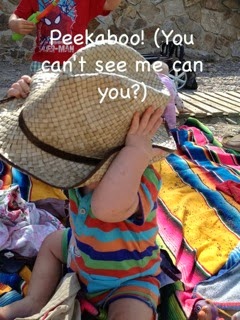
Social skills are how you interact with people around you. At roughly 6 weeks old, babies begin to smile. Laughing, playing ‘peekaboo’, waving goodbye are all examples of social skills. At 19 months old, they should show affection to familiar people, they may be scared of strangers. They may start to imitate you and do ‘pretend play’ (like feeding a doll).
The last category is Language and Hearing. Newborn babies can hear just the same as adults. (In the UK they test your hearing at birth.) To begin with they express themselves by crying. Then they start making sounds that don’t mean much. My 10 month old boy goes round saying ‘bb bb bb’ all the time. We joke that he’s really clever and is trying to say ‘ball’ or ‘bear’. Then babies start saying simple things such as ‘mama’ and ‘dada’. Gradually their vocabulary grows until they can say short sentences and then longer ones. By 19 months, most children can say several words (including ‘no’ which you may hear from time to time). They will also be able to point to something to tell you that they want it.
Children are all really different. Some speak really well at the age of 2 and others hardly say a word. That’s fine as long as they get there in the end. There are things called ‘age limits’ by which time your child is expected to be able to do a certain thing. For example, the average time of walking is 13 months, but if your child can’t walk by 18 months (the age limit) they should go and see a health professional. By 18 months I would also expect them to say single words with meaning (although many children will have more advanced verbal skills.)
Lastly, if your child starts to go backwards and loose skills that they previously had, you should definitely take them to the doctor.
To find out more about my beautiful twins and our life in Spain check out my blog at snotty-noses.com/blog. And for kids medical and health advice check out my paediatric website snotty-noses.com
